

On December 20, 2019, President Trump signed a spending package into law, part of which included the SECURE Act (Setting Every Community Up for Retirement Enhancement).
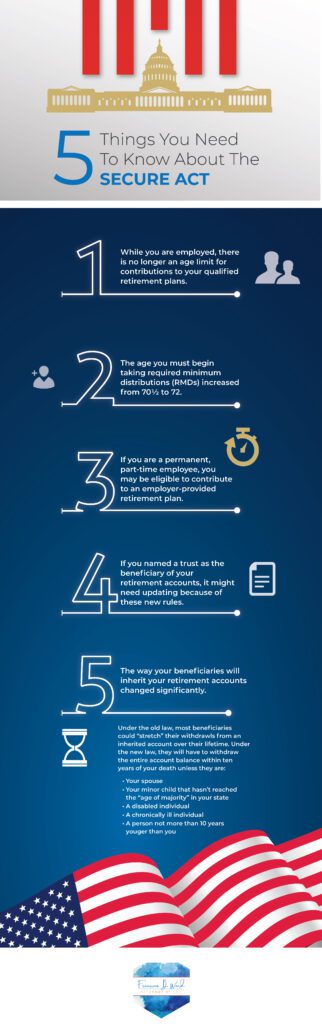
I recently wrote to my clients telling them about some of the changes made by the new law. Today, I am focusing on one of those changes—specifically, the shortening of the potential stretch time for an inherited qualified account or IRA.
In 2019 and earlier, a beneficiary who inherited a qualified account had the ability to stretch out distributions from the account. The spreading of distributions could delay the income tax result associated with account liquidation over the beneficiary’s life expectancy.
Beginning in 2020, when an account owners dies, most non-spouse beneficiaries are limited to stretching out distributions to a maximum of 10 years.
There are all kinds of special rules that can make beneficiary planning tricky. These exceptions to the 10-year liquidation rule apply when the beneficiaries are:
- The surviving spouse
- Minor children of the account owner
- Disabled or chronically ill individuals
- Named individuals no more than 10 years younger than the deceased account owner
When a trust is named the beneficiary of a qualified account, it can be hard to sort out how the post-SECURE Act stretch rule might be.
If you inherited a qualified account before this year, you are largely unaffected by the new stretch rules. However, if someone inherits that account from you before it is liquidated, their ability to continue to defer income taxes will be limited to 10 years.
The SECURE Act has created new issues for people to consider as they make beneficiary designations for their IRA and qualified accounts.
Do you have questions about the SECURE Act? Are you unsure about how the new rules might apply to the beneficiaries of your own IRAs or qualified accounts? I can help guide you through the changes in the law.
AS ALWAYS, PLEASE FEEL FREE TO CALL TO DISCUSS THESE OR OTHER FINANCIAL SECURITY ISSUES OF CONCERN.
I’m Francine D. Ward, Attorney-At-Law.
If you’re ready to create or update your Estate Plan, schedule a consultation. If you’re still gathering information, feel free to join my Facebook community for ongoing guidance and support: Legal Insights Facebook Group.
Start here:
Estate Planning FAQs
Explore other core documents in a complete estate plan:
- Preparing for Estate Planning
- What Is a Trust
- What Is an Advance Healthcare Directive
- What Is a Durable Power of Attorney
- What Is a Will
Want to explore more topics?
View all Estate Planning articles
Connect with me:
🌐 Website |
📘 Facebook |
📸 Instagram |
💼 LinkedIn |
⭐ Yelp
fRANCINE d. wARD
- Avoid ProbateAvoiding Probate — is it for you? Avoid Probate, Is that right for you? Ideally, when a loved one passes away, the administrative and financial details fade into the background.… Read more: Avoid Probate
- Disinherit a Child. Can you do it in California?Disinherit a Child. It’s Your Estate. Disinherit a child. Has disinheriting a child ever crossed your mind? If so, you are not alone. In California, it’s absolutely possible, but there… Read more: Disinherit a Child. Can you do it in California?
- AI and Estate PlanningAI and Estate Planning Artificial Intelligence (AI) is transforming nearly every area of our lives, and estate planning is no exception. AI provides powerful tools for gathering, organizing, and managing… Read more: AI and Estate Planning
- Trust Mill ScamsTrust Mill Scams. What’s Really Happening Behind the Scenes Trust Mill Scams. Estate planning scams are on the rise, especially in California. Seniors are losing an average of $34,000 per… Read more: Trust Mill Scams
- Missing Will – What if I Cannot Find it?Missing Will. A common occurrence after someone dies is that their estate documents cannot be found. The problem of the “missing will.” They may have been lost, mistakenly destroyed, intentionally… Read more: Missing Will – What if I Cannot Find it?