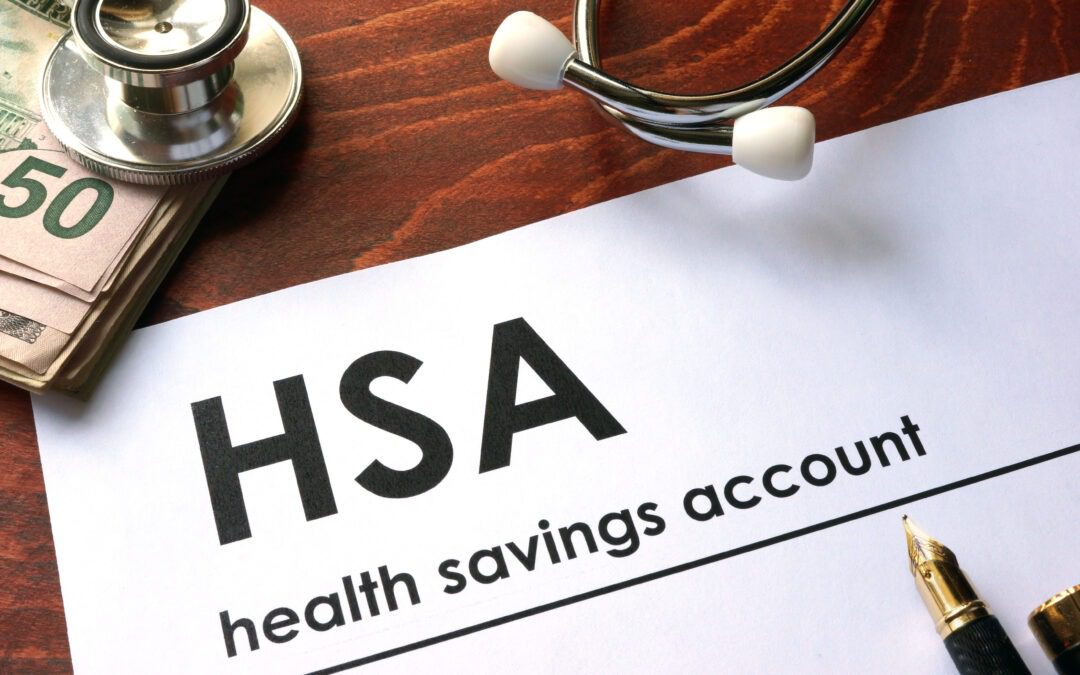
Health Savings Accounts (HSA): Many of my clients struggle with the high cost of health insurance coverage, particularly those who are still working full time. Comprehensive health insurance, whether purchased individually or provided in part in connection with employment, is expensive.
Some have found that combining a health savings account (HSA) with a high-deductible health plan can be an efficient way to lower the financial strain.
Health savings accounts (HSAs) were first created by Congress in 2003 and were used by taxpayers beginning in 2004.
Like an IRA, an HSA is a tax-exempt trust or custodial account that an individual sets up with a qualified HSA trustee to pay or reimburse medical expenses incurred by the individual or a member of that person’s family. A qualified HSA trustee can be a bank, an insurance company, or any entity already approved by the Internal Revenue Service (IRS) to be the trustee of an IRA.
The immediate advantages of setting up an HSA include the following:
- The taxpayer is allowed a federal income tax deduction for contributions that are made to the HSA, whether these contributions are made by the taxpayer or someone other than the taxpayer’s employer. This deduction is allowed even if the taxpayer does not itemize.
- Contributions made by an individual’s employer may be excluded from the employee’s income.
- Contributions by an employee to an HSA also avoid Social Security and Medicare (FICA) taxation, as do any contributions made by an employer.
- Contributions made by either the employee or the employer remain in the HSA account until they are used by the HSA owner and grow tax-deferred.
- Distributions from an HSA may be tax free if they are used to pay for qualified medical expenses.
- An health savings account, used in conjunction with an employer-provided high-deductible health plan, can be taken with an employee after leaving an employer or in retirement.
Some might even say that HSAs are superior to traditional IRAs. One reason is that withdrawals from a health savings account to pay for qualified medical expenses are always income-tax free, but withdrawals from traditional IRAs are generally subject to ordinary income tax–no matter the reason for the withdrawal.
Another advantage an health savings account has over an IRA is that there is no required minimum distribution (RMD) requirement from an HSA.
Do you have a high deductible health plan? Are you a candidate to implement an HSA? Are you searching for ways to control your health insurance costs? I would be glad to answer your questions.
AS ALWAYS, PLEASE FEEL FREE TO CALL TO DISCUSS THESE OR OTHER FINANCIAL SECURITY ISSUES OF CONCERN.
If you’re ready to create or update your Estate Plan, schedule a consultation. If you’re still gathering information, feel free to join my Facebook community for ongoing guidance and support: Legal Insights Facebook Group.
Start here:
Estate Planning FAQs
Explore other core documents in a complete estate plan:
- Preparing for Estate Planning
- What Is a Trust
- What Is an Advance Healthcare Directive
- What Is a Durable Power of Attorney
- What Is a Will
Want to explore more topics?
View all Estate Planning articles
Connect with me:
🌐 Website |
📘 Facebook |
📸 Instagram |
💼 LinkedIn |
⭐ Yelp
fRANCINE d. wARD
- Avoid ProbateAvoiding Probate — is it for you? Avoid Probate, Is that right for you? Ideally, when a loved one passes away, the administrative and financial details fade into the background.… Read more: Avoid Probate
- Disinherit a Child. Can you do it in California?Disinherit a Child. It’s Your Estate. Disinherit a child. Has disinheriting a child ever crossed your mind? If so, you are not alone. In California, it’s absolutely possible, but there… Read more: Disinherit a Child. Can you do it in California?
- AI and Estate PlanningAI and Estate Planning Artificial Intelligence (AI) is transforming nearly every area of our lives, and estate planning is no exception. AI provides powerful tools for gathering, organizing, and managing… Read more: AI and Estate Planning
- Trust Mill ScamsTrust Mill Scams. What’s Really Happening Behind the Scenes Trust Mill Scams. Estate planning scams are on the rise, especially in California. Seniors are losing an average of $34,000 per… Read more: Trust Mill Scams
- Missing Will – What if I Cannot Find it?Missing Will. A common occurrence after someone dies is that their estate documents cannot be found. The problem of the “missing will.” They may have been lost, mistakenly destroyed, intentionally… Read more: Missing Will – What if I Cannot Find it?